UK individual → UK limited company · Illustrative example
Lend £200,000 of personal funds to your company
Record principal and interest separately from salary or dividends.
Money in
UK company receives: £200,000 principal
Money out
Annual interest: £8,000 director + £2,000 HMRC
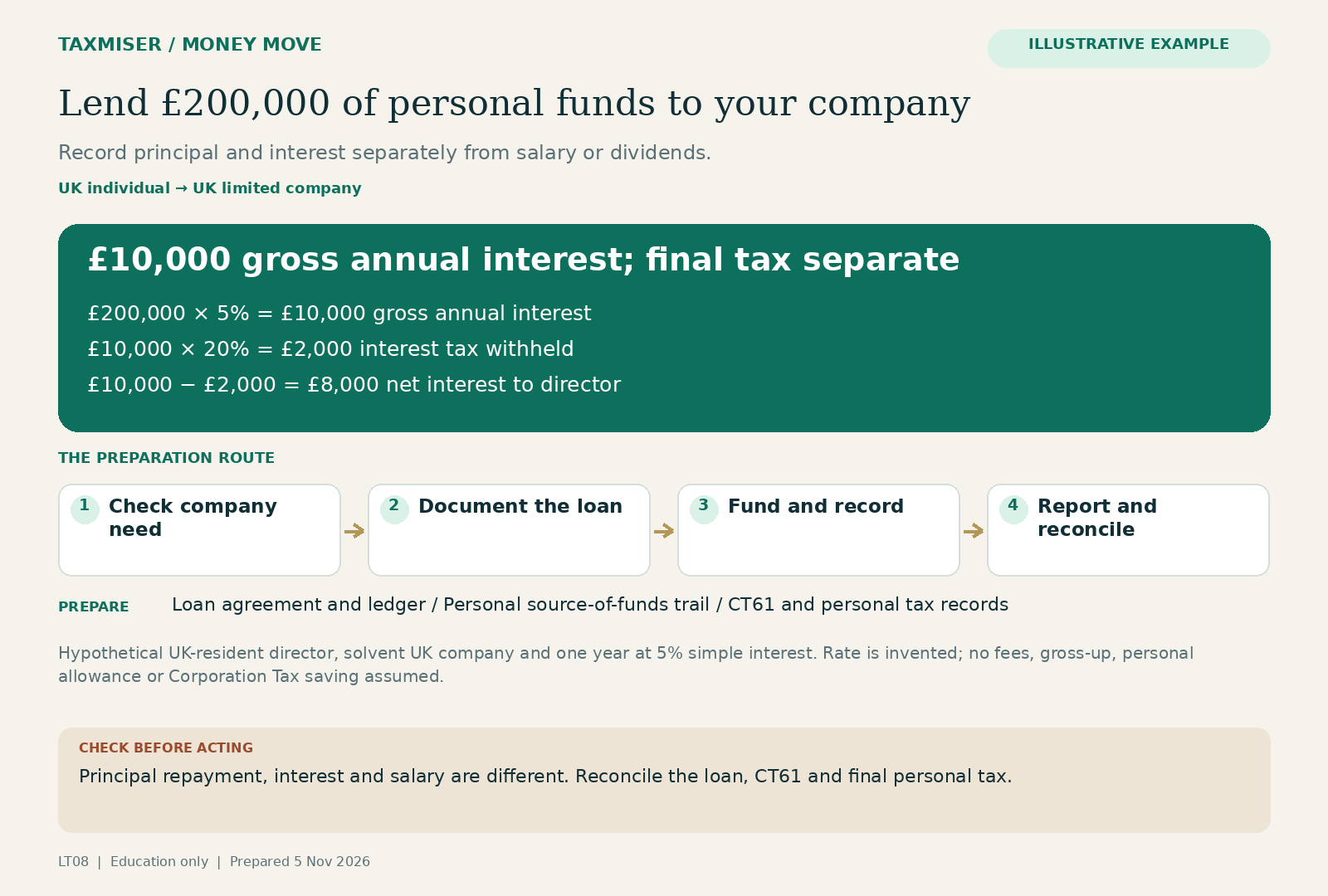
£10,000 gross annual interest; final tax separate
- £200,000 × 5% = £10,000 gross annual interest
- £10,000 × 20% = £2,000 interest tax withheld
- £10,000 − £2,000 = £8,000 net interest to director
Hypothetical UK-resident director, solvent UK company and one year at 5% simple interest. Rate is invented; no fees, gross-up, personal allowance or Corporation Tax saving assumed.
Principal repayment, interest and salary are different. Reconcile the loan, CT61 and final personal tax.
Step by step
1. Check company need and solvency
Confirm that lending is appropriate and that the company can meet its obligations; compare with a properly documented share investment.
2. Agree terms
Record amount, purpose, date, interest, repayment, security and approvals. Do not backdate a loan to re-label other payments.
3. Transfer personal funds to the company
Use verified accounts and a truthful reference; retain the personal source-of-funds trail.
4. Book the loan separately
Maintain the director’s loan balance independently of salary, dividends, expenses and share capital.
5. Process interest and reporting
Keep gross interest, director net payment and tax withheld separate; report/pay the required CT61 amounts and report personal interest income.
6. Record repayments
Reconcile each genuine principal repayment against the outstanding balance and assess solvency before repayment.
Assumptions
- A UK-resident individual director lends personal, lawfully sourced money to their solvent UK company. This is a loan to the company, not a loan from it.
- Principal is £200,000 and the fictional interest rate is 5% simple per year on unchanged principal for one year. The rate is not a tax-approved benchmark.
- The company pays interest quarterly in four equal periods. No other fees or gross-up apply.
- No personal allowance, final income-tax band or Corporation Tax saving is calculated.
- Repayment terms and any security are documented; the business has a genuine use for and capacity to service the funds.
Documents to gather
- Loan agreement and company approval
- Personal source-of-funds statements
- Company bank receipt
- Director-loan principal ledger
- Interest schedule
- CT61 returns/payment evidence
- Personal Self Assessment records
- Repayment confirmations
Tax and reporting questions
- HMRC states that the company does not pay Corporation Tax on money the director lends it. Interest is personal income for the director and must be reported appropriately.
- For the stated interest-paying director-loan example, the company deducts 20% basic-rate tax and reports/pays it quarterly using CT61. The director’s final tax is a separate calculation.
- Interest may be a company business expense, but the real commercial terms and applicable tax rules still need checking before claiming a deduction.
Risks
- Confusing a loan to the company with an overdrawn director’s loan
- Disguised salary/dividends or unsupported repayments
- Missed interest withholding/CT61
- Director credit risk if the company fails
- Uncommercial terms or undocumented security
Things we cannot know for you
- Actual company solvency and director relationship
- Commercial interest and loan conditions
- Final personal tax and company deduction
- Any security registration required
When to bring in a professional
- Material director funding
- Any distress, insolvency risk or connected-party repayment
- Company instead lends to the director
- Nonresident director or overseas company
- Loan waiver, conversion to shares or excessive interest
Educational example. Figures are assumptions, not a quote, tax ruling or guaranteed saving. Your facts and both countries’ rules matter.
My brief
Write down how this applies to you. It saves to your account as you type.
Sign in as a member to save this to your account.
Sources
- AMLG11630: Source of Funds & Source of Wealth, HMRC (checked 2026-11-05)
- Corporation Tax: return of Income Tax on company payments (CT61), HMRC (checked 2026-11-05)
- Transfer pricing: transactions between connected companies, HMRC (checked 2026-11-05)
- Director’s loans: If you lend your company money, HMRC (checked 2026-11-05)