UK → US · Illustrative example
Fund a US subsidiary with £1 million of equity
Match the cash transfer to a documented capital subscription.
Money in
UK parent pays: £1,000,050 including fee
Money out
US company receives: US$1,250,000 equity
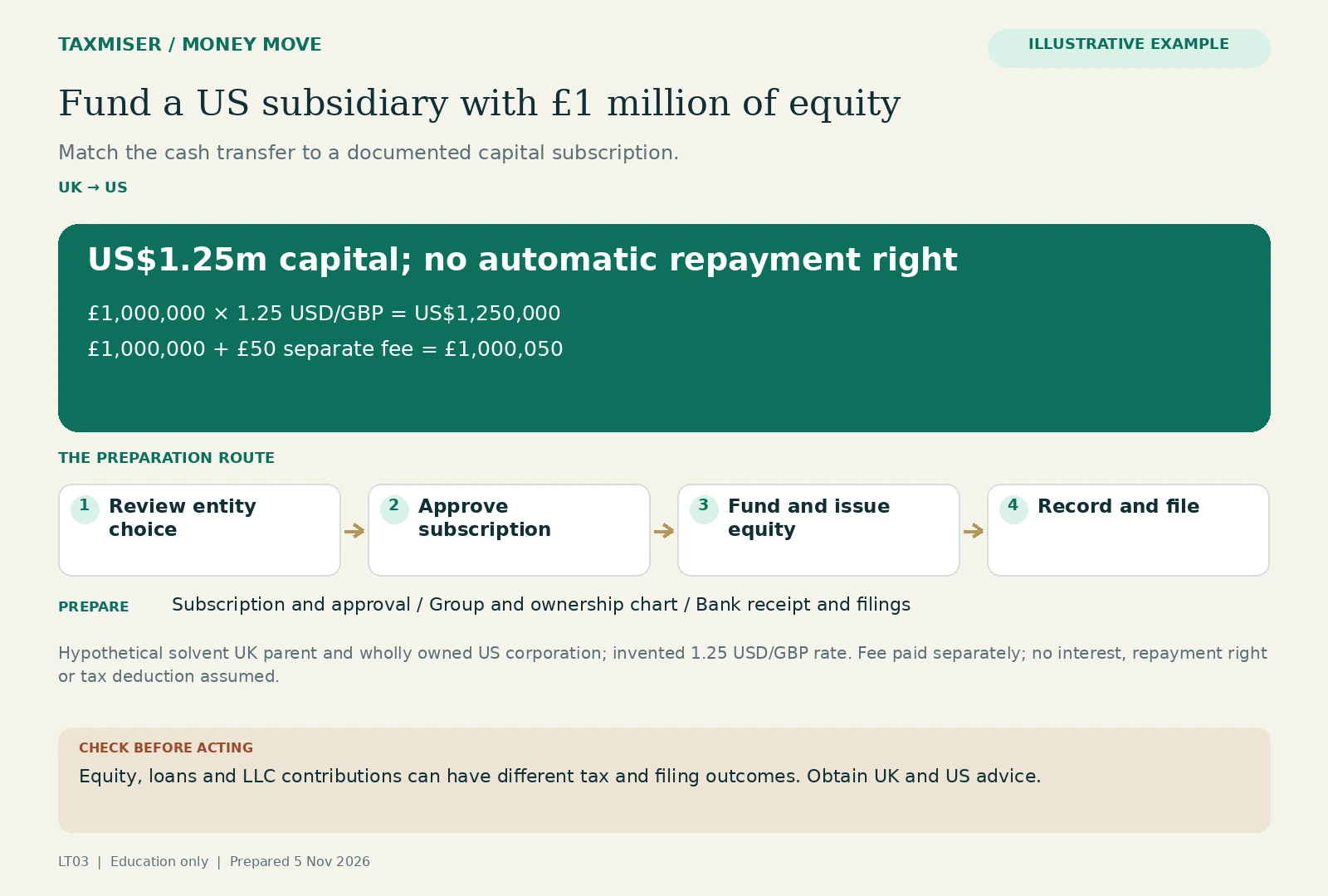
US$1.25m capital; no automatic repayment right
- £1,000,000 × 1.25 USD/GBP = US$1,250,000
- £1,000,000 + £50 separate fee = £1,000,050
Hypothetical solvent UK parent and wholly owned US corporation; invented 1.25 USD/GBP rate. Fee paid separately; no interest, repayment right or tax deduction assumed.
Equity, loans and LLC contributions can have different tax and filing outcomes. Obtain UK and US advice.
Step by step
1. Select the entity and tax treatment
Have UK and US advisers compare corporate, branch and LLC treatment, operational substance, state rules, repatriation and compliance costs.
2. Approve the investment
Document the commercial purpose, funding amount, rights, parent solvency and approvals; agree the US subscription/capital paperwork.
3. Complete bank onboarding
Use company accounts in the actual entities’ names. Supply the group chart, beneficial owners, source of funds and business plan.
4. Transfer and issue the equity
Execute the funding against the documented capital transaction; reconcile the converted receipt and update ownership/accounting records.
5. Create a filing calendar
Assign responsibility for federal/state returns and any BEA reporting or exemption. Ask separately about IRS related-party information returns.
6. Track commercial use
Keep the subsidiary’s expenditure and cash forecasts separate from the founder’s personal finances; document later loans, dividends or service charges independently.
Assumptions
- A solvent UK company forms and wholly owns a new US corporation; US counsel confirms the chosen corporate and tax classification. This is not a recommendation to form an LLC.
- The parent subscribes £1,000,000 for documented new equity; a fictional fixed conversion rate of 1.25 USD/GBP delivers $1,250,000.
- A £50 transfer fee is paid separately; the total parent cash outflow is £1,000,050.
- The entire expected establishment cost is $1,250,000, not just the first instalment. No regulated or specially restricted sector is assumed.
- No interest, automatic repayment right or tax deduction is assumed for equity funding.
Documents to gather
- UK board approval and commercial investment memo
- US incorporation and tax-classification documents
- Share subscription/capital contribution agreement
- Group and beneficial-ownership chart
- Source-of-funds statements and accounts
- Wire/FX confirmation
- Updated equity ledger and cap table
- US/UK filing calendar
Tax and reporting questions
- Calling a payment capital is insufficient by itself. HMRC expects written and accounting evidence distinguishing an overseas capital contribution from a loan.
- Qualifying new foreign direct investment can require BE-13 reporting even when no BEA letter arrives. The current exemption form uses a $40 million threshold; an otherwise qualifying smaller establishment generally needs the exemption claim within 45 days. Do not reuse old $3 million guidance.
- Form 5472 can be relevant to a 25%-foreign-owned US reporting corporation with reportable related-party transactions. If the actual structure is instead a foreign-owned US disregarded LLC, contributions/distributions can themselves be reportable and a pro-forma Form 1120 is part of that filing process.
- A disregarded LLC can also bring its foreign corporate owner into US filing analysis. Form 1120-F, UK/US classification and tax-credit issues need separate advice.
Risks
- Wrong entity or tax-classification choice
- Treating equity as repayable on demand
- Unrecognised US state or parent-company filing obligations
- Currency fluctuations
- Failure to distinguish startup cost from the amount of a single transfer
Things we cannot know for you
- State of formation and operations
- US/UK entity classification and tax residence
- Federal/state and investment-screening scope
- Current BEA transaction definitions applied to the real facts
When to bring in a professional
- Every cross-border subsidiary formation
- Any LLC or check-the-box election
- Intellectual property, regulated activity or sensitive-sector business
- Employees or management working across borders
- Any proposed cash repatriation to the founder
Educational example. Figures are assumptions, not a quote, tax ruling or guaranteed saving. Your facts and both countries’ rules matter.
My brief
Write down how this applies to you. It saves to your account as you type.
Sign in as a member to save this to your account.
Sources
- Using payment service providers, Financial Conduct Authority (checked 2026-11-05)
- AMLG11630: Source of Funds & Source of Wealth, HMRC (checked 2026-11-05)
- UK financial sanctions general guidance, Office of Financial Sanctions Implementation (checked 2026-11-05)
- INTM502050: Issues affecting equity function cases, HMRC (checked 2026-11-05)
- Instructions for Form 5472, US Internal Revenue Service (checked 2026-11-05)
- BE-13 Claim for Exemption, revision October 2025, US Bureau of Economic Analysis (checked 2026-11-05)
- Foreign corporation Form 1120-F filing responsibilities, US Internal Revenue Service (checked 2026-11-05)
- INTM180050: Foreign entity classification; HMRC view of Delaware LLCs, HMRC (checked 2026-11-05)
- International Surveys: Foreign Direct Investment in the United States, US Bureau of Economic Analysis (checked 2026-11-05)