Overseas investor → UK company · Illustrative example
Receive £1 million from an overseas investor
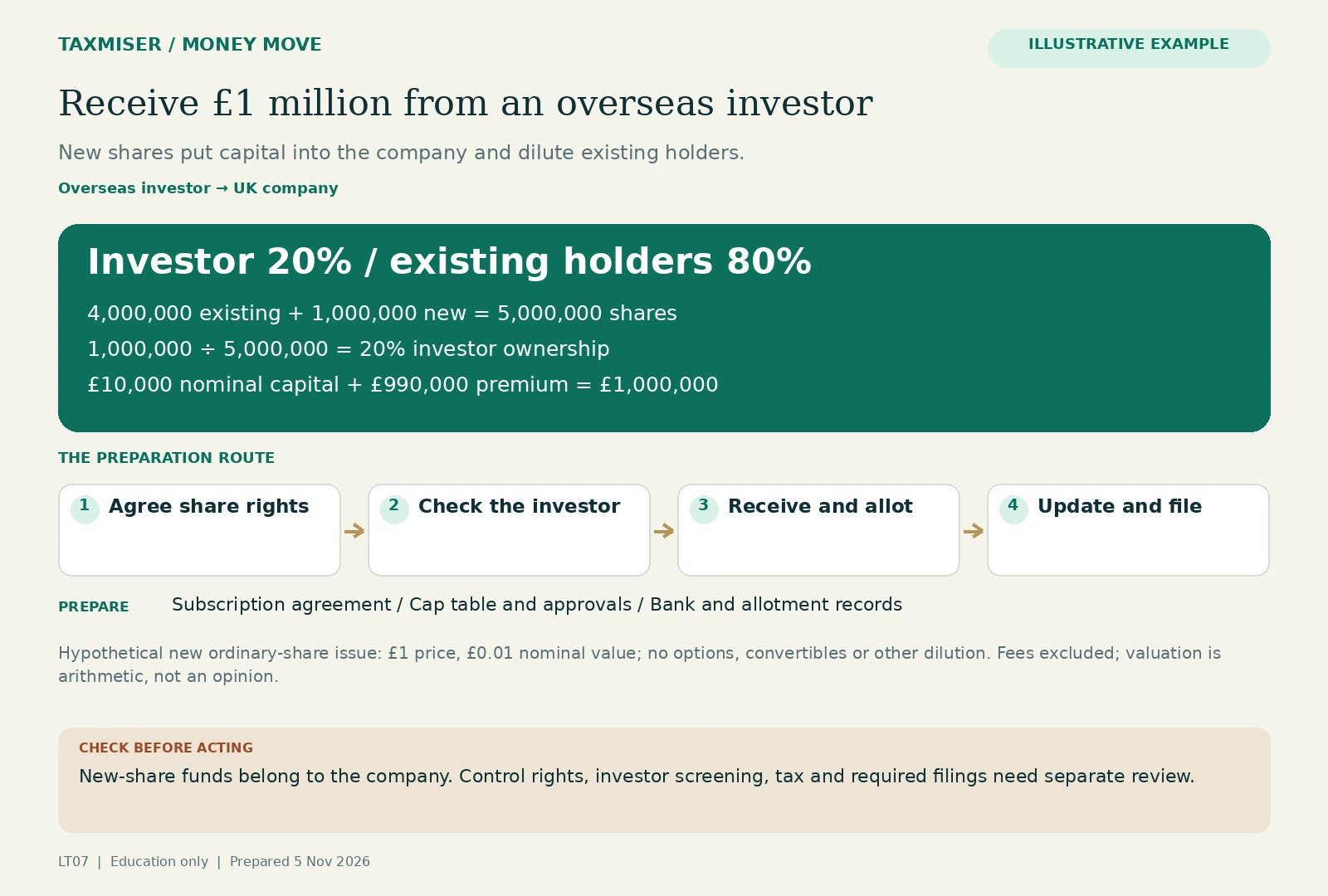
New shares put capital into the company and dilute existing holders.
Money in
UK company receives: £1,000,000 capital
Money out
Investor receives: 1,000,000 new shares
Investor 20% / existing holders 80%
- 4,000,000 existing + 1,000,000 new = 5,000,000 shares
- 1,000,000 ÷ 5,000,000 = 20% investor ownership
- £10,000 nominal capital + £990,000 premium = £1,000,000
Hypothetical new ordinary-share issue: £1 price, £0.01 nominal value; no options, convertibles or other dilution. Fees excluded; valuation is arithmetic, not an opinion.
New-share funds belong to the company. Control rights, investor screening, tax and required filings need separate review.
Step by step
1. Agree the actual security and rights
Specify new shares versus secondary shares, valuation, class, investor rights, pre-emption/approval requirements and conditions.
2. Complete investor and sector checks
Verify the investor/beneficial owners, lawful source of funds and any sanctions or investment-screening restrictions.
3. Set completion mechanics
Use a solicitor-approved subscription agreement; confirm exact entity bank details and decide when cleared funds, allotment and rights take effect.
4. Receive company funds
Pay new-share subscription money to the company under the agreed completion process, keeping it separate from any founder secondary-sale proceeds.
5. Update legal and accounting records
Complete allotment, register of members, cap table, share certificates and share-capital/premium entries as advised.
6. Complete required filings
Deliver SH01 and assess PSC changes, identity-verification duties and any sector approvals; reconcile the bank receipt to the subscription.
Assumptions
- A genuine overseas investor subscribes for newly issued ordinary shares in a UK private company, rather than buying shares from the founder.
- There are 4,000,000 existing ordinary shares and no options, convertibles, preferences or other dilutive rights.
- The company issues 1,000,000 new shares for £1 each; each share has £0.01 nominal value and £0.99 premium.
- The company receives a full £1,000,000 net; fees and any investor-side FX costs are excluded.
- The assumed economics imply £4 million pre-money and £5 million post-money values. They are arithmetic assumptions, not a valuation opinion.
Documents to gather
- Subscription agreement and approved company resolutions
- Updated articles/shareholder agreement when relevant
- Cap table before/after on a clearly defined basis
- Investor beneficial-owner and source-of-funds evidence
- Company bank receipt
- Allotment/register/share certificates
- SH01 and PSC/approval evidence
Tax and reporting questions
- New-share subscription proceeds belong to the company and form capital. A purchase of an existing founder’s shares pays the selling shareholder instead.
- New-share allotments generally require an SH01 return and statement of capital within one month.
- PSC analysis includes more than 25% shares/votes and other forms of control. A 20% holding is not by itself sufficient to decide the result if other control rights exist. Current identity-verification and change-reporting rules also apply.
- Some transactions in sensitive sectors need mandatory national-security notification; foreign investment is not automatically exempt from screening merely because it funds new shares.
- A genuine subscription to new shares is different from buying existing shares for UK Stamp Duty/SDRT purposes. Do not apply the share-transfer treatment to every capital raise.
Risks
- Money sent to a founder instead of the issuing company
- Cap-table arithmetic omitting options or preferences
- Unexpected control or pre-emption rights
- Missing allotment/PSC filings
- Treating a headline valuation as independently verified
Things we cannot know for you
- Investor residence and beneficial owners
- Fully diluted capital structure
- Company articles and transaction permissions
- NSI and financial-promotion implications of the real offer
When to bring in a professional
- Every material equity financing
- Preference shares, convertibles, options or secondary sales
- Foreign corporate ownership chains
- Sensitive-sector business or control rights
- Any tax-relief eligibility marketed to investors
Educational example. Figures are assumptions, not a quote, tax ruling or guaranteed saving. Your facts and both countries’ rules matter.
My brief
Write down how this applies to you. It saves to your account as you type.
Sign in as a member to save this to your account.
Sources
- AMLG11630: Source of Funds & Source of Wealth, HMRC (checked 2026-11-05)
- UK financial sanctions general guidance, Office of Financial Sanctions Implementation (checked 2026-11-05)
- Life of a company: event-driven filings, section 7.9, Companies House (checked 2026-11-05)
- People with significant control (PSCs), Companies House (checked 2026-11-05)
- National Security and Investment Act: notifiable acquisitions, UK Government (checked 2026-11-05)
- CG50285: Issue of shares, subscription and purchase, HMRC (checked 2026-11-05)
- Tax when you buy shares, HMRC (checked 2026-11-05)