US → UK; GBP loan · Illustrative example
Lend £600,000 from a US group firm to the UK
Separate the loan principal, interest payment and tax withheld.
Money in
UK borrower receives: £600,000 principal
Money out
Annual interest: £28,800 lender + £7,200 HMRC
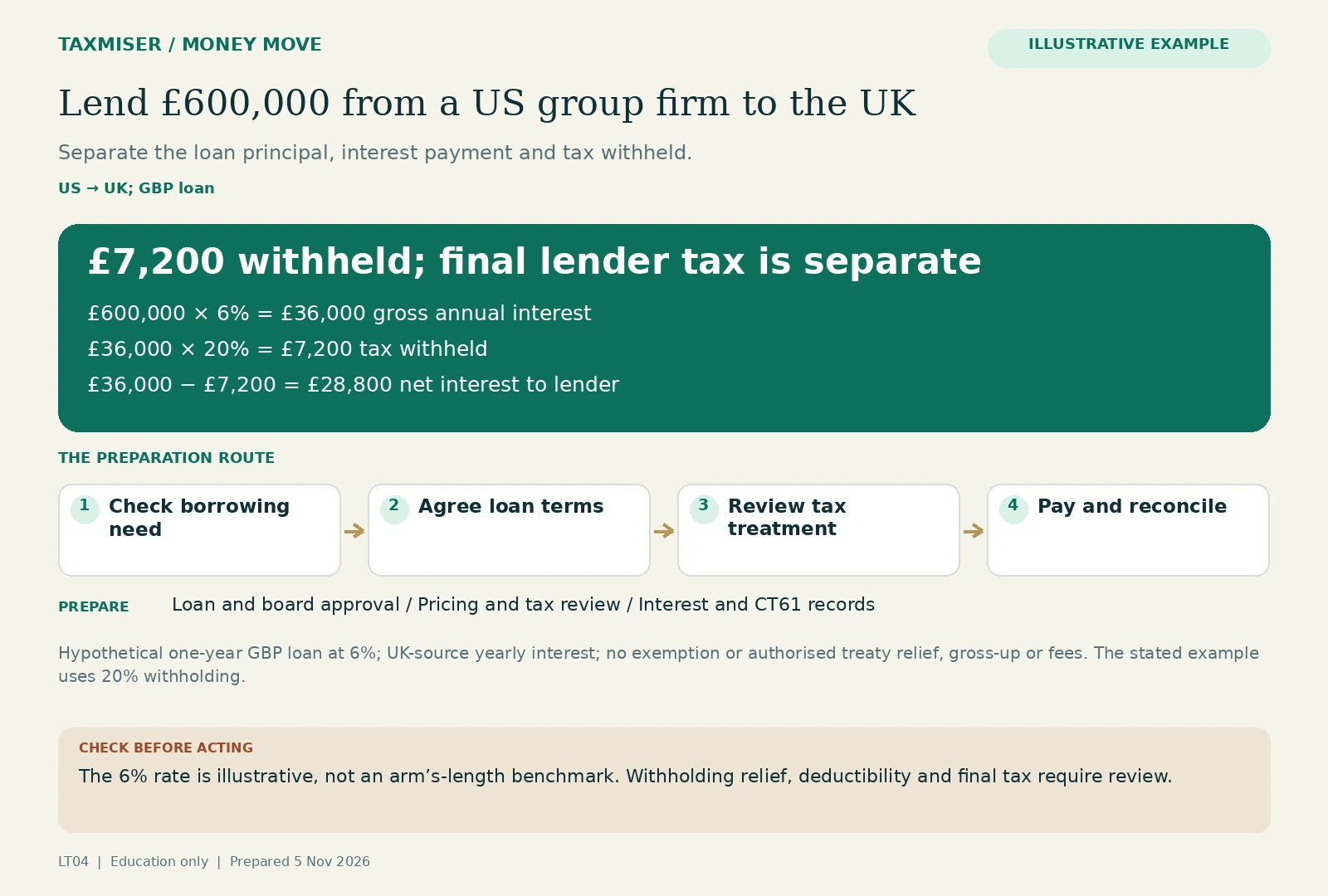
£7,200 withheld; final lender tax is separate
- £600,000 × 6% = £36,000 gross annual interest
- £36,000 × 20% = £7,200 tax withheld
- £36,000 − £7,200 = £28,800 net interest to lender
Hypothetical one-year GBP loan at 6%; UK-source yearly interest; no exemption or authorised treaty relief, gross-up or fees. The stated example uses 20% withholding.
The 6% rate is illustrative, not an arm’s-length benchmark. Withholding relief, deductibility and final tax require review.
Step by step
1. Confirm borrowing need and capacity
Document how much the UK company needs, why debt is appropriate and how it can service and repay the loan.
2. Agree commercial terms
Set currency, maturity, interest, security, repayment, defaults and tax gross-up terms; gather comparable financing evidence.
3. Resolve tax before the first interest payment
Have advisers analyse transfer pricing, interest deductibility, withholding, treaty eligibility and any claim/authorisation procedure.
4. Transfer and book principal
Execute the documented advance to the company account and reconcile both companies’ loan ledgers.
5. Pay and report interest correctly
Apply the approved withholding treatment; separate lender payment from HMRC remittance and submit required returns.
6. Review changes
Revisit prolonged arrears, extensions, changes in group ownership, extra advances and refinancing rather than leaving undocumented balances.
Assumptions
- A US corporate lender advances GBP 600,000 to a UK corporate borrower for a genuine commercial purpose. Both remain solvent.
- The fictional loan bears 6% simple yearly interest on unchanged principal for exactly one year. This rate is not a safe harbour or an arm’s-length conclusion.
- The interest is assumed UK-source yearly interest, and no exemption or HMRC-authorised treaty relief applies to the illustrated payment.
- A 20% UK withholding rate is used for that explicitly defined no-relief example. The lender’s final tax, tax credits and any gross-up are excluded.
- No gross-up clause, arrangement fee or FX conversion is included in the arithmetic.
Documents to gather
- Signed loan agreement and board approvals
- Borrower cash-flow/repayment forecast
- Commercial pricing analysis or adviser conclusion
- Beneficial-ownership and residence documentation
- Treaty application/authorisation where relevant
- Loan and interest ledgers
- CT61 returns and tax-payment evidence
- Bank confirmations
Tax and reporting questions
- UK-source yearly interest paid to a nonresident generally requires deduction; the exact result depends on statutory exemptions and any valid treaty claim.
- Treaty relief is not automatic. Do not pay gross merely because a treaty exists or because the group owns both companies.
- Related-party financing needs a transfer-pricing and deductibility analysis. SME and domestic exemptions are not a blanket permission for arbitrary rates; current notice provisions changed for chargeable periods beginning from 1 January 2026.
Risks
- Non-deductible or recharacterised interest
- Withholding failures and missed returns
- Mispriced interest or borrowing beyond repayment capacity
- Unpriced tax gross-up obligation
- An informal balance becoming long-term financing
Things we cannot know for you
- Source of interest under actual facts
- Applicable statutory exemptions and treaty conditions
- Actual commercial rate and deductibility
- Foreign tax treatment and availability of credit
When to bring in a professional
- Every cross-border related-party loan
- Treaty relief or gross payment requested
- Interest-free, deeply subordinated or perpetual terms
- Hybrid entities/instruments
- Distress, loan waiver or conversion into equity
Educational example. Figures are assumptions, not a quote, tax ruling or guaranteed saving. Your facts and both countries’ rules matter.
My brief
Write down how this applies to you. It saves to your account as you type.
Sign in as a member to save this to your account.
Sources
- SAIM9200: Payment of interest overseas, HMRC (checked 2026-11-05)
- Corporation Tax: return of Income Tax on company payments (CT61), HMRC (checked 2026-11-05)
- Claiming Double Taxation Relief for companies and other concerns, HMRC (checked 2026-11-05)
- Transfer pricing: transactions between connected companies, HMRC (checked 2026-11-05)
- INTM414330: Transfer pricing notices, HMRC (checked 2026-11-05)